
Total Portfolio Approach versus Strategic Asset Allocation: Which is best?
One single answer to that question may not exist. Yet we can still aim to clearly identify where institutional investors may find a tension between these two approaches. That way we can start to create a framework for bringing the best sides of both into the portfolio construction process.
Anyone who has been a teacher or student at a business school has seen firsthand how academic departments within the same management program can approach problems differently. We suspect the difficulty lies here: Total Portfolio Approach (TPA) and Strategic Asset Allocation (SAA) put the theory you learned from your finance professor into direct conflict with the theory you learned from your organizational management professor.
Let’s take a step back and define what we mean by these two approaches.
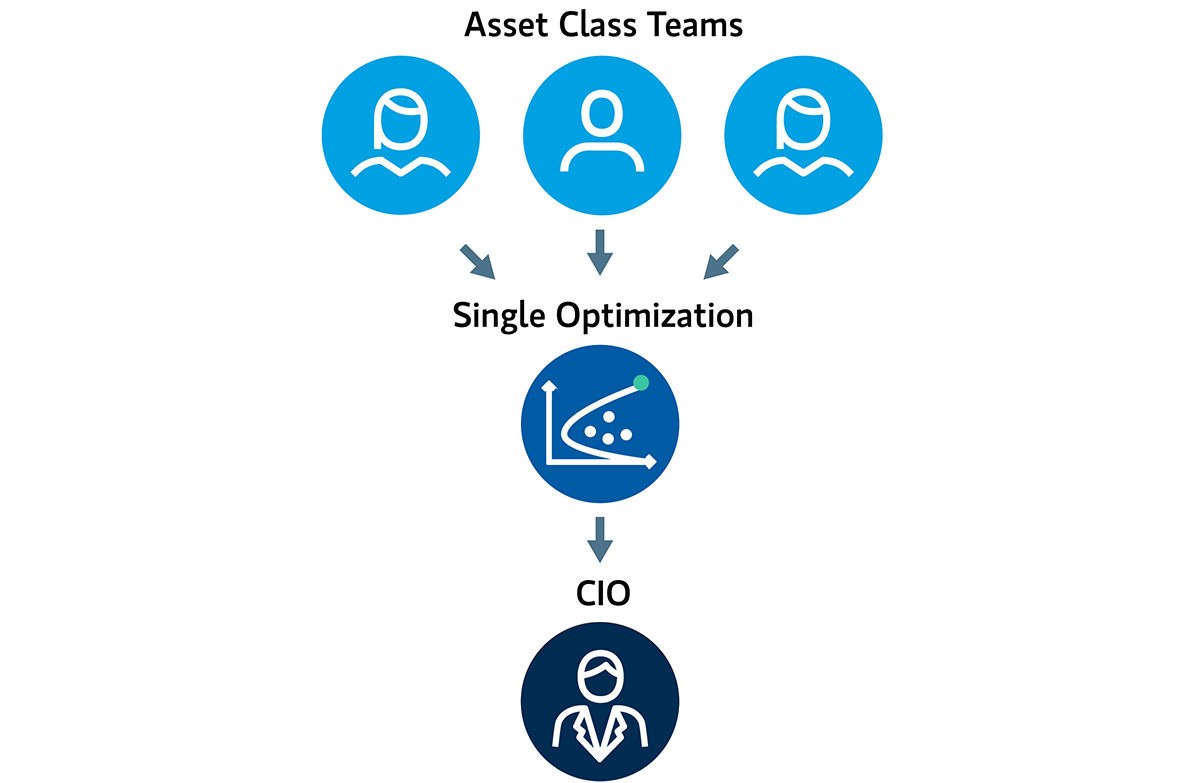
Total Portfolio Approach is fundamentally a bottom-up investment organizational strategy, which recognizes that attractive investments can emerge from many different places, that those places may change over time and that investments sourced from different places may still be correlated at the portfolio level. By pushing the investment sourcing lower in the organization and then allocating to those investments while accounting for shared fundamental and factor exposures, TPA makes our old finance professor proud.
TPA: Stronger total portfolio optimization, weaker asset-class accountability
Each asset class team contributes to the asset allocation, viewed as a single optimization owned by the CIO. This incorporates more asset class information and team viewpoints when running the optimization.
For illustrative purposes only.
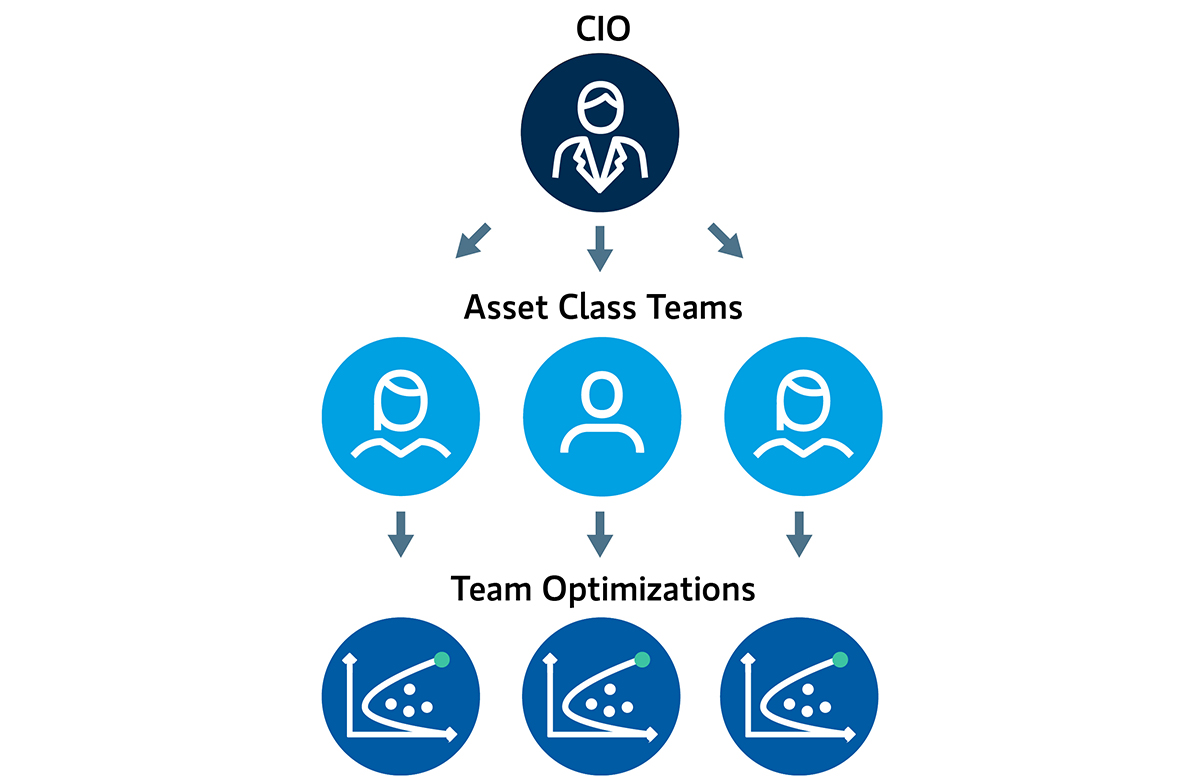
Strategic Asset Allocation is fundamentally a top-down investment organizational strategy, in which the lead investor chooses broad asset-class exposures at the highest level of the organization, then provides allocation targets based on that to individual teams operating in something closer to silos. Obviously, leadership should also take into account correlations at the asset-class level in designing the SAA—and if not, maybe it’s time to look for new leadership? But once those allocations are designated, the sleeve leaders make decisions within their asset classes and answer for their sleeve’s outcomes. SAA’s clearly defined structure of responsibility and accountability makes our old management professor proud.
SAA: More emphasis on asset-class decision-making, less optimal total portfolio exposures
The CIO allocates to each asset class team, who then runs their own optimizations separately. This provides more organizational control of and accountability for each silo.
For illustrative purposes only.
Take more control through Cross-Asset Portfolio Solutions
At their most extreme, these two approaches exist in tension with one another. The SAA approach bewilders our finance professor, who correctly points out that we might get too much equity risk if our fixed income manager loads up on high yield credit and convertible bonds without talking to the equity team leadership. And TPA frustrates our management professor, who worries that nobody is entirely accountable for the asset-class performance that comes from this broader optimization.
So there’s a conflict between the best practices from two different business school fields. What can an investor do about it? We think the right path forward is to acknowledge the conflict and try to use the best aspects of both approaches.
For some organizations—particularly those facing investment and asset-class constraints—that may look more like top-down SAA, but using a multi-asset risk model at the asset-class level to stay within risk boundaries and maintain balance. For others—particularly more nimble and higher trust organizations—that may look more like bottom-up TPA, but using a multi-asset risk model to adjust the factor characteristics of the total portfolio, helping to benchmark the individual investments.
The bottom line
Which organization are you? Which professor do you think your team needs more right now, the organizational- and incentive-minded management guru or the financial theory optimizer? And how heavily do you need to lean in their direction? These are the questions that will help you determine where on the TPA-to-SAA spectrum you ultimately land.
The views expressed in these posts are those of the authors and are current only through the date stated. These views are subject to change at any time based upon market or other conditions, and Parametric and its affiliates disclaim any responsibility to update such views. These views may not be relied upon as investment advice and, because investment decisions for Parametric are based on many factors, may not be relied upon as an indication of trading intent on behalf of any Parametric strategy. The discussion herein is general in nature and is provided for informational purposes only. There is no guarantee as to its accuracy or completeness. Past performance is no guarantee of future results. All investments are subject to the risk of loss. Prospective investors should consult with a tax or legal advisor before making any investment decision. Please refer to the Disclosure page on our website for important information about investments and risks.
08.24.2028 | RO 5839066