
Higher yields and improved funding levels have strengthened the case for cashflow-matched portfolios. Public plans with outflows that exceed contributions may want to review the strategy.
Sponsors of public pension plans that pay out more in benefits than they receive in participant contributions may want to take a fresh look at cashflow matching. In today’s higher-yield market environment, a cashflow-matching strategy may help plans meet their near-term payment obligations while preserving assets needed to pursue required long-term return targets.
Generating funds with cashflow matching
Cashflow matching (CFM) involves aligning the timing and amount of portfolio cash flows—including coupon payments and principal repayments—with a known schedule of future liability payments. Done correctly, CFM may help ensure that sufficient cash flow is available when liabilities come due.
Alternative approaches such as duration and key-rate hedging work differently by keeping the present value of assets moving roughly in step with liabilities as yields shift. While these strategies can be effective tools, they may not perfectly match investment cashflows with benefit payments and generally require frequent asset adjustments to address changing dynamics. By contrast, CFM generally requires less frequent portfolio rebalancing.
Unfortunately, plan sponsors may not hear about CFM as a viable strategy until an endgame conversation takes place—somewhere between an actuarial review and a buyout quote. In our view, this timing is unfortunate, because the strategy generally works for most funding ratios. If we line up future bond cashflows with the payments they cover, a lion’s share of funding problems could be resolved, and plan sponsors would be less reliant on optimal market conditions (market timing) to meet their plan’s payment obligations.
Higher yields revive the case for cashflow matching
CFM has become an attractive option as higher bond yields and improved plan funding levels have changed the liability-driven investment environment.
With bond yields well above what they were earlier this decade, CFM now works better alongside duration hedging and overlays because high-quality bonds pay investors more today than in the past. Moody’s seasoned Aaa yield averaged 6.03% in September 2026, up from 2.14% in July 2020. The broad ICE BofA US Corporate Index closed at 6.02% on September 30, 2026, with investment-grade bonds trading at levels investors had written off five years earlier. When high-quality income is available, the opportunity cost of locking in coverage falls.
Moody’s Seasoned Aaa Corporate Yield Has Risen Steadily Since July 2020
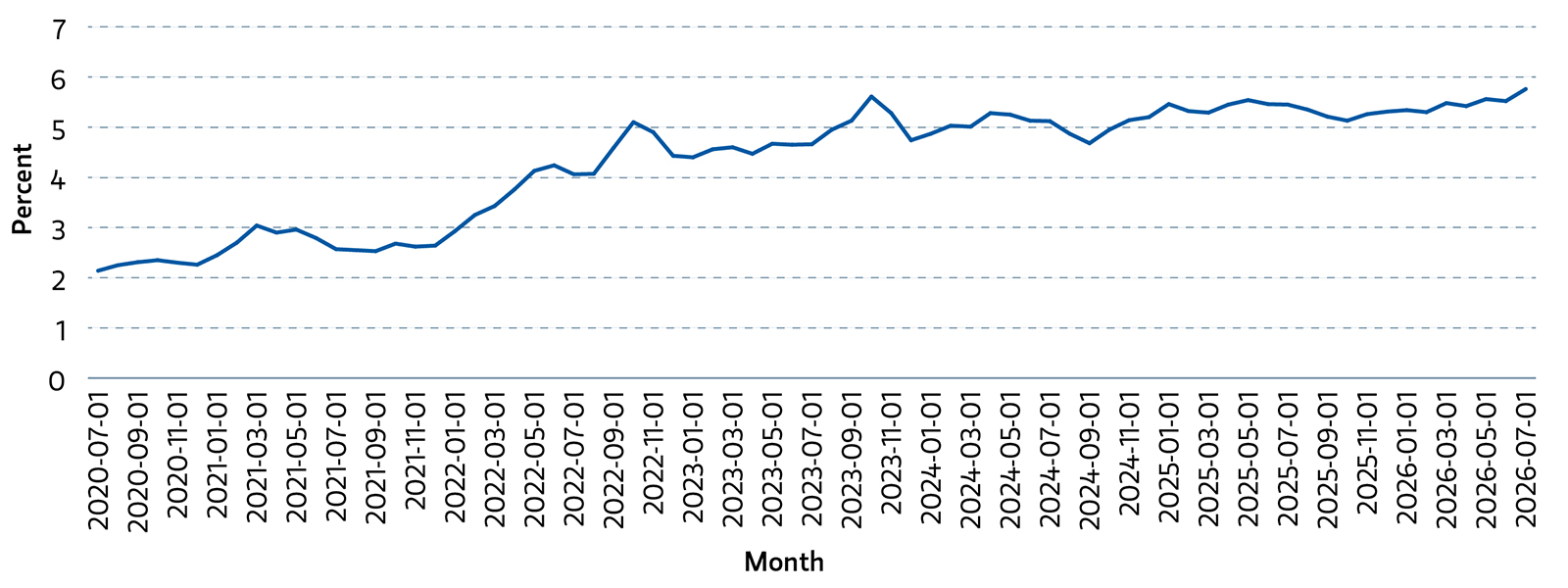
Source: Moody’s via FRED. Data as of September 2026. For illustrative purposes only. Not a recommendation to buy or sell any security. All investments are subject to risk, including the risk of loss.
Plan funding is stronger than ever
US pension plans are in their strongest financial position in years. Milliman’s 2026 Corporate Pension Funding Study of the100 largest US corporate defined benefit plans reported a 103.8% aggregate funded ratio and a $48.1 billion surplus at fiscal year-end 2025, up from $13.4 billion a year earlier.1 That surplus allows sponsors to revisit a question that was difficult to address when interest rates were near historic lows: What liabilities can they now afford to finance with greater certainty? However, with spreads well inside of recent wides, credit selection is especially important in CFM, as a single downgrade can be more costly to a portfolio than when yields were low. This puts a premium on issuer selection and bond market surveillance.
Managing public plans with net outflows
US public pension plans with outflows that exceed contributions face liquidity challenges that hedge-ratio tools do not fully address. Milliman projected the 100 largest US public defined benefit plans would pay $387 billion in benefits and expenses between July 2025 and June 2026, against $289 billion in contributions, a structural cash outflow that requires an alternative source of funding.2
100 Largest US Public Plans Face $98 Billion Net Outflow in 2026
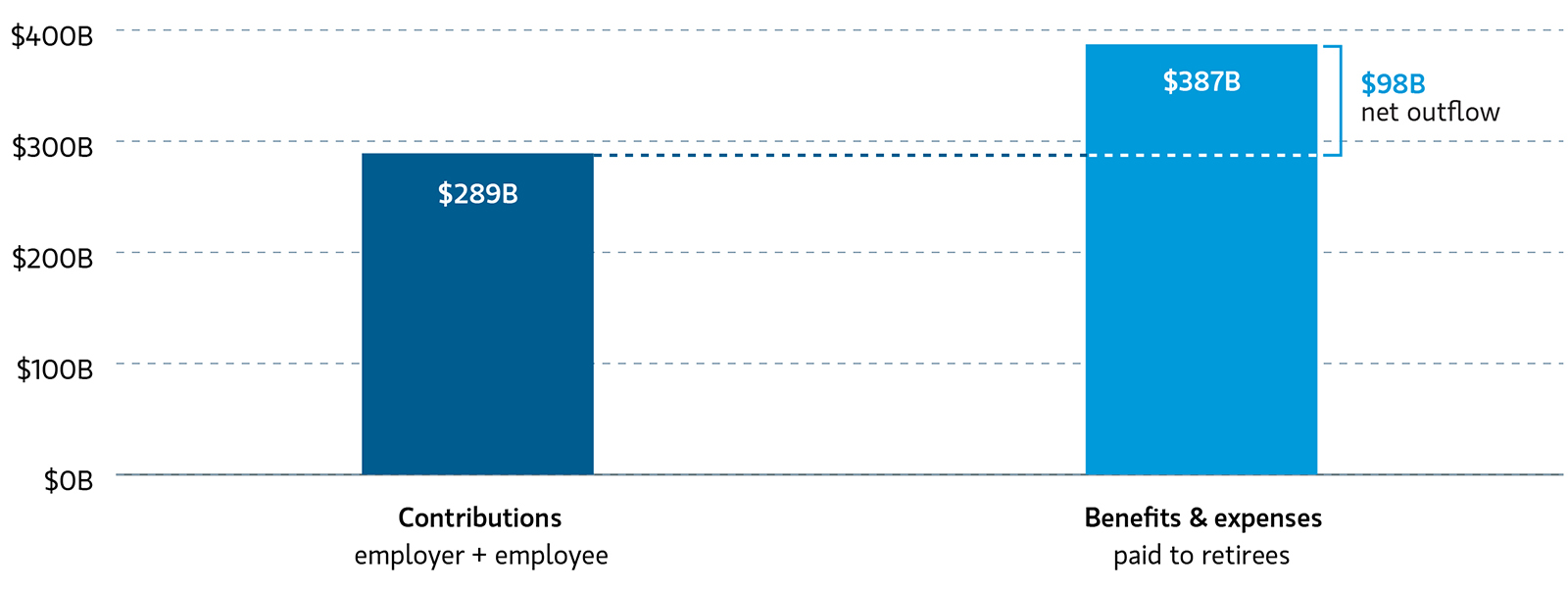
Source: Milliman, 2025 Public Pension Funding Study. For illustrative purposes only.
Unlike a corporate plan, a public plan’s reported discount rate is generally tied to a long-term expected-return assumption rather than market yields, making a full hedge-ratio framework an awkward fit. CFM is a more natural solution because it allows plans to fund several years of benefits from a dedicated fixed income sleeve while keeping the rest of the portfolio invested to pursue the plan’s long-term return targets.
CFM may help mitigate sequence-of-returns risk. This can occur when plans with negative cashflow are forced to sell return-seeking assets to pay retiree benefits, potentially locking in losses during market downturns. By contrast, a matched sleeve that produces income in sync with a payment schedule reduces the need for forced asset sales and mitigates the drag on the plan’s funded status.
Refine and enhance liability-driven investing strategies
Mature plans may benefit most from cashflow matching
Cashflow matching can help when a plan has visible near-term payments and wants to avoid selling return-seeking assets at the wrong moment to meet its obligations. This may be the scenario for mature public plans, where benefit payrolls can exceed contributions and the annual cash need is more predictable than returns.
A dedicated cashflow-matched sleeve may add the most value when:
• Near-term outflows are large and reasonably predictable.
• The plan is mature, with a sizable retiree payroll relative to contributions.
• Forced selling into a drawdown would be costly.
• The liability schedule is stable enough to model with confidence.
While the same CFM logic extends to insurers and foundations with scheduled payouts, the math is clearest for public plans. The choice isn't “matching versus hedging” but how much of the plan payout schedule to match. For most, the answer is both: a matched sleeve for the near years, a hedged tail behind it and return-seeking assets sized against a real horizon. Hedge-ratio debates get cleaner once the next several years of checks sit in known bonds.
CFM requires active management
Cashflow matching isn't a set-and-forget strategy. Matching a fixed income inflow to a liability far in the future remains challenging because underlying factors can change. Liabilities can shift as mortality, lump-sum elections, inflation and benefit patterns change, requiring ongoing portfolio monitoring and adjustment. Exact matching far out on the curve can be costly as conditions change. That’s why execution—including bond selection, efficient trading and reinvestment—matters as much as credit selection.
Credit surveillance and execution are part of the solution
A robust cashflow-matched portfolio depends on two things: selecting the right bonds and trading them efficiently. Credit selection determines whether the cashflows arrive on time; execution determines the premium paid for the liquidity needed to meet future obligations. Our process starts with fundamental credit analysts maintaining an approved issuer list and continuous surveillance focused on ratings stability and downside risk mitigation. This method strives to screen out fallen angels—issuers whose bonds have transitioned out of the investment grade corporate bond index due to downgrades or defaults—and has the potential to uncover problem credits before financial markets and rating agencies react.
Building a matched portfolio also means continuous portfolio rebalancing and reinvesting as the schedule evolves. In 2025, our trading desk executed more than $68 billion in transactions across municipal and taxable markets. These orders represented roughly 5% of customer-to-dealer municipal volume and 3% of investment-grade corporate trades. Such volumes improve dealer access and compound in basis points over decades.
The bottom line
US cashflow matching is one of several liability-driven investing tools available to investors. Its relevance doesn't depend on duration hedging becoming less effective. Rather, bond yields above 6% have made the strategy more affordable than it's been for most of the past decade. Current surplus funding levels among US public plans give plan sponsors and fund managers more options and flexibility. For public plans, whose reported liabilities move largely independently of market yields, the focus is less on hedge ratios and more on ensuring that near-term benefit payments can be met without relying on market timing.
1 Milliman, 2026 Corporate Pension Funding Study, 2026.
2 Milliman, 2025 Public Pension Funding Study, 2026.
The views expressed in these posts are those of the authors and are current only through the date stated. These views are subject to change at any time based upon market or other conditions, and Parametric and its affiliates disclaim any responsibility to update such views. These views may not be relied upon as investment advice and, because investment decisions for Parametric are based on many factors, may not be relied upon as an indication of trading intent on behalf of any Parametric strategy. The discussion herein is general in nature and is provided for informational purposes only. There is no guarantee as to its accuracy or completeness. Past performance is no guarantee of future results. All investments are subject to the risk of loss. Prospective investors should consult with a tax or legal advisor before making any investment decision. Please refer to the Disclosure page on our website for important information about investments and risks.
LDI programs utilize fixed income securities, including corporate bonds. Corporate debt securities are subject to the risk of the issuer’s inability to meet principal and interest payments on the obligation and may also be subject to price volatility due to such factors as interest rate sensitivity, market perception of the creditworthiness of the issuer and general market liquidity. When interest rates rise, the value of corporate debt securities can be expected to decline. Debt securities with longer maturities tend to be more sensitive to interest rate movements than those with shorter maturities. Company defaults can impact the level of returns generated by corporate debt securities. An unexpected default can reduce income and the capital value of a corporate debt security. Furthermore, market expectations regarding economic conditions and the likely number of corporate defaults may impact the value of corporate debt securities.
10.31.2027 | RO 5997150