
Recent bond market repricing has pushed municipal yields to levels not seen in decades and improved the potential risk-reward profile for fixed income. Here, we examine why municipals stand out, how supportive credit fundamentals shape the opportunity and why investors may benefit from extending maturities to lock in attractive tax-exempt income.
Fixed income markets have repriced sharply in recent weeks amid investor concerns about rising inflation, Federal Reserve (Fed) policy and the prospect of interest rates remaining higher for longer.
Yields across high-quality fixed income are now near their highest levels in two decades, with municipal bonds standing out in particular. Tax-exempt yields have risen significantly, creating an opportunity for investors to lock in attractive income by extending maturities along the municipal yield curve—all while underlying credit fundamentals for municipal issuers remain stable and broadly supportive.
For investors in higher tax brackets, today’s combination of elevated absolute yields and tax efficiency has created one of the more compelling municipal bond opportunities in years. This becomes even more significant in the context of long-term planning, with taxable-equivalent yields nearing levels more commonly associated with equity returns.
Higher yields offer a stronger entry point
Longer-term rates increasingly reflect a broader set of forces, including persistent inflation, resilient growth, higher real rates, elevated Treasury note issuance and a higher term premium.
In our view, the magnitude of the recent decline in bond prices and corresponding rise in yields has pushed yields toward the upper end of the range justified by current economic conditions. If inflation pressures moderate, and economic growth remains positive, today’s yields may already reflect considerable uncertainty around Fed policy, inflation and Treasury supply. While rising yields have weighed on bondholders in the near term, they have also significantly improved the forward-looking risk-reward profile for fixed income.
Higher yields offer investors greater compensation for interest-rate and inflation uncertainty—and a larger cushion against further rate volatility. As a result, bonds may generate attractive returns through income, without relying on falling rates.
Municipals: A compelling opportunity
The broader bond-market reset has sent municipal yields to 20-year highs. Higher Treasury yields, heavy new issuance, tax-loss selling and weaker trading volumes have all contributed. Importantly, the magnitude of this trend has not been matched by a comparable deterioration in municipal credit fundamentals. State and local government fundamentals remain broadly healthy, supported by strong balance sheets and elevated reserves.
For investors in higher tax brackets, taxable-equivalent yields across portions of the municipal curve now compare favorably with many taxable fixed income alternatives and are approaching levels historically associated with long-term equity return expectations.
Municipal Yields Stand Above 20-Year Averages: Higher for California and New York Investors
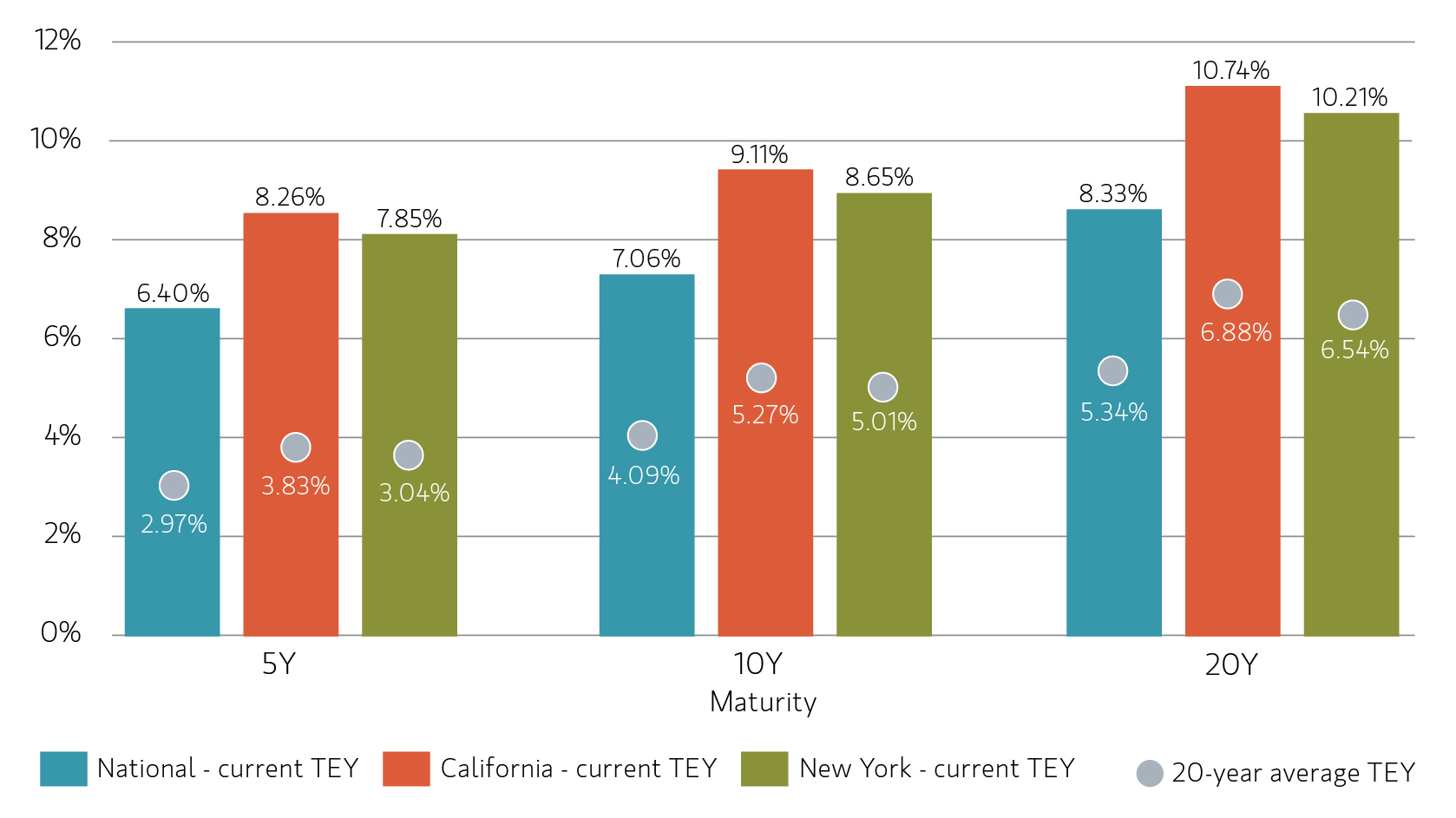
Note: Dots on bars indicate 20-year yield averages.
Source: MMD (Municipal Market Data) AAA curve, sheet “MMD Jan. 1, 1996 through Sept. 29, 2026.” National: 40.8% federal (37% + 3.8% NIIT). CA: 40.8% federal +13.3% state = 54.1%. NY: 40.8% federal + 10.9% state = 51.7%. Assumes in-state bonds, same muni yields across all three, no state tax deduction on federal return. For illustrative purposes only. Past performance is no guarantee of future results.
Higher yields change the fixed income vs. equity trade-off
For much of the past decade, investors seeking higher long-term returns had limited alternatives to taking more equity risk. Today, that trade-off looks different.
Taxable-equivalent municipal yields are approaching levels often used in long-term equity return assumptions, while offering contractual income, defined maturities and substantially different risk characteristics. The question is no longer simply whether municipal yields are attractive relative to their own history, but whether today’s fixed-income opportunity warrants a larger role in long-term asset allocation.
Positioning along the yield curve also matters. Elevated short-term rates gave investors little incentive to move beyond cash or short maturities in recent years. The municipal curve now offers more compensation for extending maturities. That may create an opportunity to extend moderately along the curve, lock in attractive tax-exempt income and help reduce reinvestment risk. Investors do not necessarily need to make a large duration call. A laddered approach can spread maturity exposure, while periods of volatility may create opportunities for relative-value trading, tax-loss harvesting and portfolio repositioning.
Solutions for today’s complex interest rate environments
The bottom line
Interest-rate volatility may persist as markets assess inflation, Fed policy, economic growth and Treasury supply. But if energy markets stabilize, inflation pressures moderate and the economy continues to expand at a measured pace, we believe the recent repricing may have pushed yields beyond the upper end of the range justified by current economic conditions.
These conditions have materially improved the forward-looking risk-reward profile for fixed income, with current yields offering greater income and a larger cushion against further rate increases.
Municipals stand out in this environment. Elevated tax-exempt yields, attractive taxable-equivalent income and broadly supportive credit fundamentals create a compelling opportunity for investors seeking tax-efficient income.
For long-term investors, the opportunity does not depend on identifying the exact peak in interest rates. Instead, it is about locking in tax-exempt income at levels not seen in decades.
Fixed income securities are subject to the ability of an issuer to make timely principal and interest payments (credit risk), changes in interest rates (interest-rate risk), the creditworthiness of the issuer and general market liquidity (market risk). In a rising interest-rate environment, bond prices may fall and may result in periods of volatility and increased portfolio redemptions. In a declining interest-rate environment, a portfolio may generate less income. Longer-term securities may be more sensitive to interest rate changes. An imbalance in supply and demand in the municipal market may result in valuation uncertainties and greater volatility, less liquidity, widening credit spreads and a lack of price transparency in the market. There generally is limited public information about municipal issuers..
The views expressed in these posts are those of the authors and are current only through the date stated. These views are subject to change at any time based upon market or other conditions, and Parametric and its affiliates disclaim any responsibility to update such views. These views may not be relied upon as investment advice and, because investment decisions for Parametric are based on many factors, may not be relied upon as an indication of trading intent on behalf of any Parametric strategy. The discussion herein is general in nature and is provided for informational purposes only. There is no guarantee as to its accuracy or completeness. Past performance is no guarantee of future results and is not meant to depict the performance of a specific investment. All investments are subject to the risk of loss. Prospective investors should consult with a tax or legal advisor before making any investment decision. Please refer to the Disclosure page on our website for important information about investments and risks.
9.30.2027 | RO 5976704