

The corporate bond market is structurally less efficient than equities, with investment-grade indexes increasingly tilted toward lower-quality issuers. Let’s explore how active management can help improve credit selection, manage duration and capture opportunities that passive approaches may miss.
Why the Intermediate Corporate SMA belongs in the core of a fixed income allocation
In fixed income, the default for many advisors has become passive ETFs or self-managed portfolios. Both are reasonable starting points, but they can leave meaningful value on the table. Corporate credit is not the equities market: The bond market is structurally inefficient, and those inefficiencies create opportunities for a hybrid approach that blends rules-based exposure with active credit research, new-issue participation and tax-loss harvesting.
The IG index you're buying is not the IG index you remember
The quality composition of the investment grade (IG) corporate universe has shifted materially over recent decades. BBB—the lowest rung of investment grade—has gone from roughly a quarter of the ICE BofA US Corporate Index in 1990 to nearly half today, while the AA and above share has collapsed from a third to less than 10%. A passive IG allocation is, by construction, a bet on the lowest tier of investment grade credit.
Investment Grade Index Has Drifted Lower in Credit Quality (1990 – 2025)
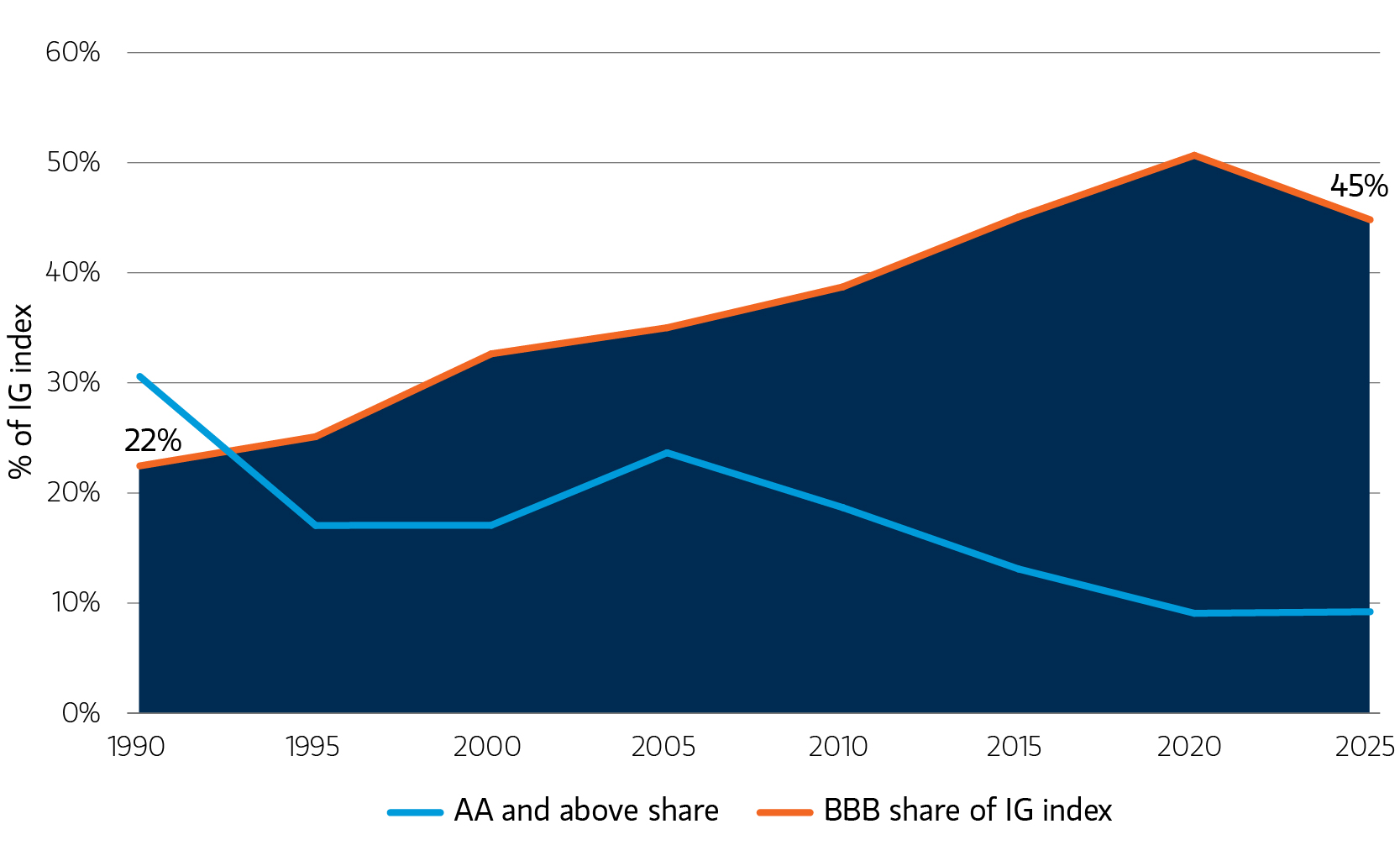
Source: ICE BofA US Corporate Index, as of 12/31/2025. For illustrative purposes only. Not a recommendation to buy or sell any security. It is not possible to invest directly in an index. Indexes are unmanaged and do not reflect the deduction of fees or expenses.
Why this matters for advisors: Increased credit risk can make passive IG vehicles more vulnerable to market volatility and issuer downgrades. When a BBB issuer is downgraded to high yield, an ETF and its investors can become forced sellers at the worst possible time. During the 2020 downgrade wave, the US investment grade market contributed $88 billion of fallen-angel supply to high yield.
Why active works in fixed income
Corporate credit markets have structural features that create persistent inefficiencies. Active managers seek to capitalize on these opportunities, while passive vehicles generally cannot. Among the most important:
Debt-weighted indexes. Bond benchmarks weight issuers by debt outstanding—the most indebted issuers get the largest weights, which may be backwards from a risk perspective.
Non-economic holders. Central banks, insurers and banks own roughly half the global bond market and may buy for reasons unrelated to total return—leaving opportunities on the table.
Forced turnover. Bonds mature, get called and get downgraded. Passive vehicles trade on a schedule dictated by the index, creating predictable price impacts that active managers can seek to capitalize on.
New-issue concessions. Corporates generally price new deals at a concession to secondary levels to ensure efficient execution. Active managers with scale can participate; passive funds cannot.
How Active Management May Benefit Fixed Income Investors (5-Year Period: 6/30/2020 - 6/30/2025)
In contrast to equities, bond markets can be less efficient, creating more opportunities for active managers to add value, as illustrated below.

Source: Morningstar. Past performance is not indicative of future results. Percentages reflect the portion of fixed income and equity active managers that outperformed or underperformed their respective benchmarks for the periods shown, according to their Morningstar categories. All investments are subject to risk, including the risk of loss. Comparing the management and performance of a separately managed account to an exchange-traded fund is not a true and equal comparison due to differences in guidelines and restrictions, fees and expenses, and cash flows, among other factors. Because of these disparities, investors and clients are cautioned against undue reliance on separate account and fund comparisons.
The long-term data bear this out. According to Morningstar, active bond managers have beaten their respective benchmarks roughly two-thirds (64%) of the time over the five-year period June 30, 2020, through June 30, 2025. In contrast, active equity managers outperformed their benchmarks only 24% of the time over the same period. Morningstar's most recent Active/Passive Barometer1 continues to identify fixed income as the category where active management has the highest historical success rate.
How we implement managed corporate SMAs
We apply three levers, consistently and transparently:
Duration and yield-curve positioning. Portfolio duration is a deliberate expression of our macro view—the path of the fed funds rate, term premium, inflation trajectory and Treasury supply and demand. We size duration tilts within tight guardrails around the benchmark to position the portfolio in a similar way to an intermediate IG allocation, seeking to allow curve positioning to work for clients rather than against them.
Sector and security selection. Our credit research team covers every major IG sector. Dedicated analysts maintain continuous dialogue with management teams, rating agencies and sell-side desks. The objective is simple: identify mispriced risks and avoid idiosyncratic loss. A single downgrade from IG to high yield may produce a price drop of several points as index funds and IG-only mandates become forced to sell.
New-issue participation for incremental alpha. We are active participants in the primary market. Leveraging the institutional capabilities of Morgan Stanley Investment Management, we see new issues pricing daily and can selectively take allocations at concessions unavailable to secondary-market buyers. Over a full cycle, capturing even modest new-issue concessions has the potential to compound into meaningful excess return in an asset class where total returns are measured in single digits.
This represents how the portfolio management team generally implements its active SMA investment process under normal market conditions. There is no guarantee that the investment objectives will be met. All investments are subject to risk, including the risk of loss.
At a glance: Active SMA vs. Passive IG ETFs
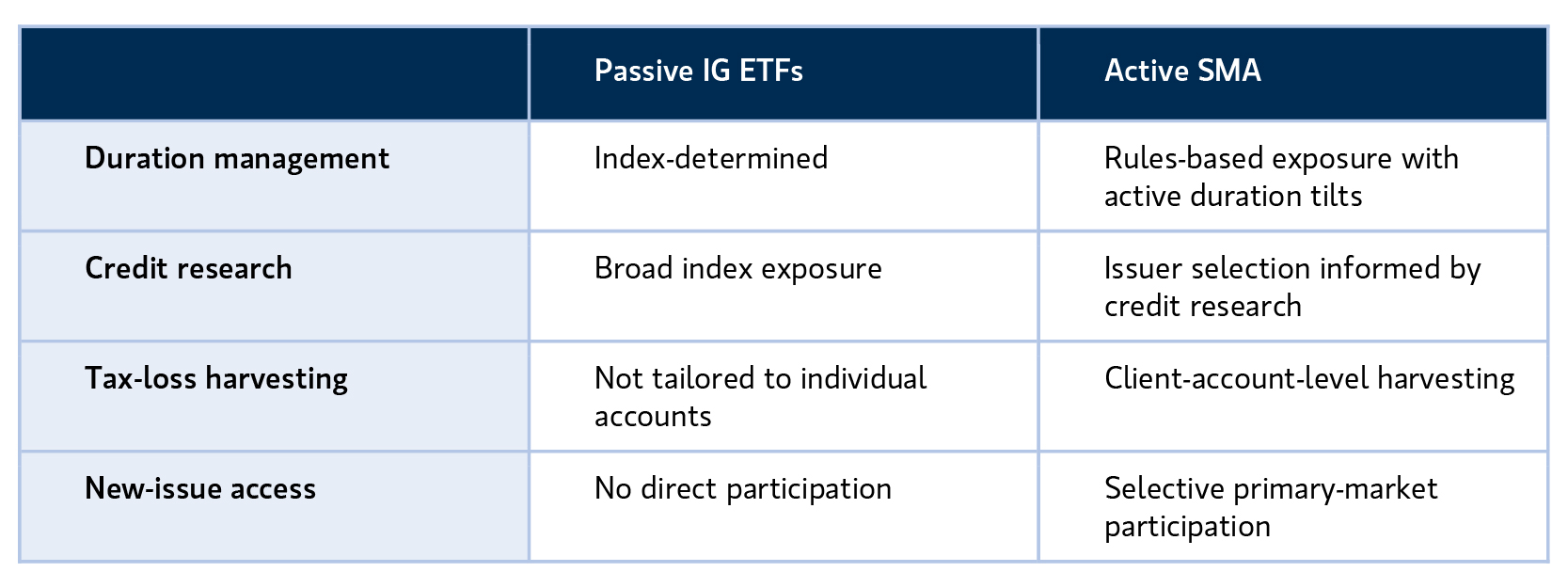
Comparing the management and performance of a separately managed account to an exchange-traded fund is not a true and equal comparison due to differences in guidelines and restrictions, fees and expenses, and cash flows, among other factors. Because of these disparities, investors and clients are cautioned against undue reliance on separate account and fund comparisons.
Why this matters now
Spreads are near the lower end of their historical range, leaving little margin for error in credit selection. Interest coverage and leverage metrics remain solid across IG, but dispersion at the issuer and sector levels is rising, with weakening fundamentals in parts of media, software, basic materials and nonbank financials. In our view, this is precisely the type of environment where credit research and investment discipline has the potential to add value—and where broad index exposure may look less attractive.
1 Morningstar’s Active/Passive Barometer is a semiannual report that tracks the percentage of active funds that both survive and outperform comparable passive funds over time, net of fees.
Past performance is no guarantee of future results. The returns referred to in the blog are those of representative indexes and are not meant to depict the performance of a specific investment.
Parametric and Morgan Stanley do not provide legal, tax, or accounting advice or services. Clients should consult with their own tax or legal advisor prior to entering into any transaction or strategy described herein.
The views expressed in these posts are those of the authors and are current only through the date stated. These views are subject to change at any time based upon market or other conditions, and Parametric and its affiliates disclaim any responsibility to update such views. These views may not be relied upon as investment advice and, because investment decisions for Parametric are based on many factors, may not be relied upon as an indication of trading intent on behalf of any Parametric strategy. The discussion herein is general in nature and is provided for informational purposes only. There is no guarantee as to its accuracy or completeness. All investments are subject to the risk of loss. Diversification does not eliminate the risk of loss. Fixed income securities are subject to the ability of an issuer to make timely principal and interest payments (credit risk), changes in interest rates (interest rate risk), the creditworthiness of the issuer and general market liquidity (market risk). In a rising interest-rate environment, bond prices may fall and may result in periods of volatility and increased portfolio redemptions. In a declining interest-rate environment, the portfolio may generate less income. Longer-term securities may be more sensitive to interest rate changes. Please refer to the Disclosure page on our website for important information about investments and risks.
08.31.2027 | RO 5791735