
The path of yields in 2025 created meaningful opportunities for tax-aware fixed income investors—but only for those positioned to act in real time. As volatility subsided later in the year, the importance of timing and systematic tax management became more clear.
The fixed income market followed a volatile course last year: Yields moved sharply higher early on, then retraced through the middle of the year, before ultimately settling lower when markets gained more confidence in the economic outlook and the Federal Reserve’s cautious, data-dependent approach.
As outlined in our 2026 outlook for fixed income, the resilient economy was supported by a strong consumer and ongoing investment activity—even though inflation stayed above target and policymakers faced a narrow path forward. That mix of resilience and uncertainty kept rate volatility elevated at times, particularly at the beginning of the year, before subsiding as 2025 drew to a close.
For tax-aware investors, this sequence mattered. Some of the most meaningful tax loss harvesting opportunities emerged during periods of heightened volatility. After market conditions stabilized later in the year, those opportunities became harder to capture—underscoring why timing plays such a critical role in fixed income tax management.
Turning rate volatility into tax opportunity
In fixed income, unlike equities, tax loss harvesting opportunities are often driven by changes in interest rates and yield curves rather than issuer-specific credit events. When yields rise, bond prices fall—sometimes briefly—before recovering as rates stabilize or decline.
Tax loss harvesting often involves swapping into similar bonds to maintain portfolio exposure while realizing a loss. Here’s an illustration to show how this process works in practice:
How tax loss harvesting works in fixed income
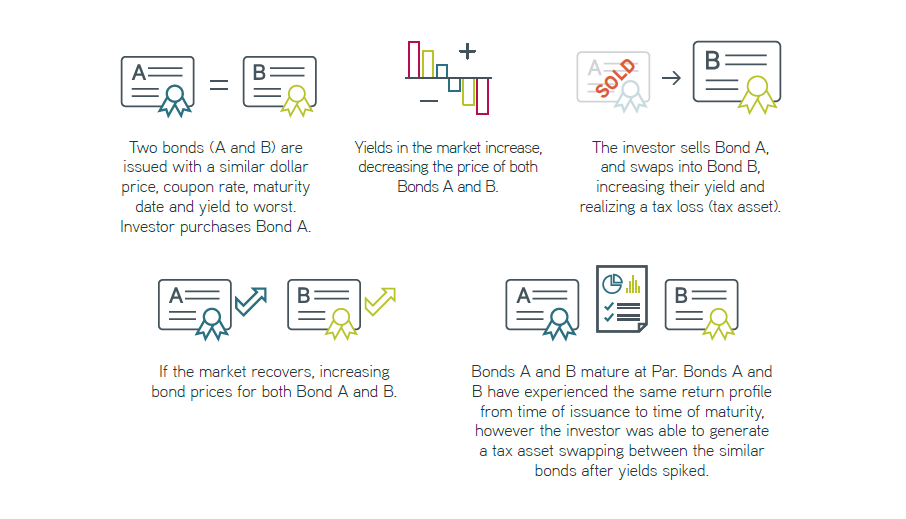
For illustrative purposes only. This represents how a portfolio management team could generally implements its investment process under normal market conditions. All investments are subject to risk, including risk of loss.
Last year provided a clear example. Early yield increases created windows where bonds traded below cost, presenting opportunities to realize losses. As yields moved lower and volatility subsided, many of those losses narrowed or disappeared. Investors relying solely on year-end portfolio reviews risked missing those windows altogether.
This dynamic highlights an important distinction: Tax loss harvesting opportunities in bonds can be frequent, but they are often short-lived. Capturing them requires ongoing monitoring and the ability to act when markets move, rather than waiting for a calendar-driven review.
Boost bond potential with active tax management
Systematic tax management makes a difference
Research from Cerulli Associates reinforces why tax loss harvesting should be a core capability rather than a tactical feature. According to Cerulli, tax customization ranks among the most important portfolio priorities for both high net worth and mass affluent investors, with after-tax outcomes increasingly driving investment decisions.1
A systematic tax loss harvesting process may help investors capture losses as they occur, while efficiently replacing positions and maintaining intended portfolio exposures. Over time, those realized losses become tax assets that can offset current gains or be carried forward, providing flexibility well beyond the moment when they are harvested.
In fixed income portfolios, execution matters. Without the technology, scale and trading infrastructure to monitor portfolios continuously, many managers are limited to periodic or year-end harvesting. In a year like 2025—when volatility created opportunities early but faded later—that approach risked leaving meaningful tax savings on the table.
Supported by our proprietary technology, Parametric sold more than $13.4 billion in market value to realize $362 million in net losses in 2025—resulting in an estimated $122 million in potential tax savings for Fixed Income SMA investors.2
The macro backdrop presented in our 2026 outlook suggests that interest rate uncertainty and episodic volatility are likely to persist. Even if markets remain broadly resilient, shifts in policy expectations, inflation dynamics or economic growth could continue to create intermittent windows for tax-aware action, which would make a systematic approach even more valuable.
The bottom line
Tax loss harvesting in fixed income works best when it’s a continuous element of the portfolio management process. In an environment where rate movements can be swift and opportunities fleeting, the ability to harvest losses when they appear may help to meaningfully improve after-tax outcomes.
For fixed income investors focused on long-term results, we believe the timing of tax loss harvesting should be central to the strategy, not a secondary consideration in the portfolio.
1 Cerulli Associates is an international research and consulting firm that provides financial institutions with guidance in strategic positioning and new business development. This study was sponsored by Parametric. Parametric is not affiliated with Cerulli Associates or any of its affiliates.
2 Source: Parametric, 12/31/2025. The information is provided for illustrative purposes only. Values are aggregated across all municipal, corporate and preferred strategies with managed, laddered or total return mandates. Only client positions with unverified cost basis were excluded from calculations. Loss calculation is based on the amortized book price minus the sell price, represents historical information and should not be construed as future results. Loss information illustrates the effect to a portfolio and is not representative of, and should not be construed as, performance. There is no assurance that tax loss harvesting will continue in the future. There is no guarantee that any specific account may engage in tax loss harvesting.
Parametric and Morgan Stanley do not provide legal, tax, or accounting advice or services. Clients should consult with their own tax or legal advisor prior to entering into any transaction or strategy described herein.
The views expressed in these posts are those of the authors and are current only through the date stated. These views are subject to change at any time based upon market or other conditions, and Parametric and its affiliates disclaim any responsibility to update such views. These views may not be relied upon as investment advice and, because investment decisions for Parametric are based on many factors, may not be relied upon as an indication of trading intent on behalf of any Parametric strategy. The discussion herein is general in nature and is provided for informational purposes only. There is no guarantee as to its accuracy or completeness. Past performance is no guarantee of future results. All investments are subject to the risk of loss. Prospective investors should consult with a tax or legal advisor before making any investment decision. Please refer to the Disclosure page on our website for important information about investments and risks.
01.08.2028 | RO 5105924